
Payroll Automation—Where Should You Invest Next?

If you only had enough budget for one payroll technology investment next year, where would you spend it? It’s a question many payroll leaders are facing as organizations continue to expect more from payroll while providing fewer resources to get there.
Compliance continues to become more complex. Employees expect faster service and self-service options, and leadership wants more data, better reporting, and greater efficiency. Meanwhile, payroll teams are often leaner than they’ve ever been.
The good news is that payroll technology has never been more capable. The challenge isn’t finding technology, it’s deciding which investments will deliver the greatest value.
 One Process at a Time
Many organizations make the mistake of thinking they must automate everything at once. In reality, successful payroll transformation usually happens one process at a time.
Start with the work that consumes the most manual effort, delivers measurable value, and creates momentum for future improvements. One helpful way to think about automation is through a maturity model.
Many organizations begin with spreadsheets and manual processes. From there they move into basic payroll system automation, followed by integrated workflows between systems.
More mature organizations begin using analytics and intelligent automation before eventually incorporating predictive capabilities and artificial intelligence (AI) into their payroll operations. The goal isn’t to jump directly to AI, it’s to build a solid foundation first.
Workflow Automation
So where should payroll leaders focus? One of the highest-impact investments is workflow automation—approval routing, new hire setup, retroactive payroll requests, ticket routing, and off-cycle payment approvals are all examples of repetitive processes that can often be automated.
Removing manual handoffs reduces delays, improves audit trails, and allows payroll professionals to spend more time solving complex issues instead of chasing approvals. However, automation should never replace good governance.
Recent legal challenges surrounding AI-assisted recruiting have reminded organizations that technology does not eliminate accountability. Even when a vendor provides AI capabilities, employers remain responsible for understanding how decisions are made, validating results, and maintaining appropriate human oversight.
Payroll may not be screening job candidates, but the lesson still applies. Responsible automation always includes governance.
System Integration
Another area that often delivers significant value is system integration. For years, organizations have relied on flat files moving between HR, timekeeping, payroll, finance, and tax vendors.
While these interfaces work, they often require manual monitoring and troubleshooting. Application programming interfaces (APIs) allow systems to communicate directly with one another, reducing manual intervention and providing more timely data.
These interfaces can significantly improve payroll efficiency, but they also require proper monitoring. Every integration should include guardrails and alerts, so failed transactions are identified before they become payroll issues.
Employee Self-Service
Another implementation that most organizations consider to be a worthwhile investment is employee self-service (ESS). Every address change, direct deposit update, tax election, or pay statement that employees can access themselves is one less request for the payroll team to process.
ESS allows payroll professionals to focus on work that truly requires their expertise while improving the employee experience at the same time.



What's your dream payroll
technology investment?
Analytics, Dashboards
Beyond operational improvements, payroll leaders should also think about visibility. Analytics and dashboards can help organizations identify trends in payroll errors, off-cycle payments, processing timelines, tax adjustments, labor costs, and compliance metrics.
Instead of simply reporting what happened last pay period, payroll can begin identifying patterns and predicting future needs. That kind of data is increasingly valuable when partnering with finance and executive leadership.
AI Tools
Finally, there’s AI, which has quickly become one of the most talked-about technologies in payroll, but it’s important to remember that AI works best as an assistant, not as a decision-maker.
Today’s AI tools can help draft employee communications, summarize legislative updates, create standard operating procedures (SOPs), organize knowledge, and even summarize payroll variances. These capabilities can save significant amounts of time.
Meanwhile, payroll professionals should never assume AI is always correct. Critical decisions still require professional judgment, compliance expertise, and human review. Technology should support payroll professionals, not replace them.
 Evaluating Investments
When evaluating potential investments, ask the following questions:
- Does this reduce manual effort?
- Does it improve compliance?
- Does it improve the employee experience?
- Will it scale as our organization grows?
- Does it integrate with our existing technology?
- Does it have measurable success metrics?
If the answer to most of those questions is yes, the investment is probably worth exploring.
A More Automated Future
Payroll has always been about accuracy, compliance, and trust. Automation doesn’t change those fundamentals; it simply gives payroll professionals more time to focus on the strategic work that adds value to the organization.
The future of payroll isn’t about replacing people with technology. It’s about eliminating repetitive work so payroll professionals can spend more time doing what only they can do: applying expertise, exercising sound judgment, and delivering an exceptional payroll experience.
The best automation strategy isn’t necessarily the most sophisticated one—it’s the one that solves your biggest problem first.
Alma Stewart, CPP, is Senior Manager, Global Payroll, at Docusign with 31 years of payroll experience spanning compliance, taxation, operations, and transformation. She is a member of PayrollOrg’s Ask an Expert Committee; Board of Contributing Writers; Certification Item Development Task Force; the Child Support, Electronic Payments, Garnishments, and State and Local Topics Subcommittees of the Government Relations Task Force (GRTF); Social Networking Committee; and the Best Practices, Emerging Technologies, Global Payroll, and Shared Services Subcommittees of the Strategic Payroll Leadership Task Force (SPLTF). She received PayrollOrg’s Meritorious Service Award in 2022.
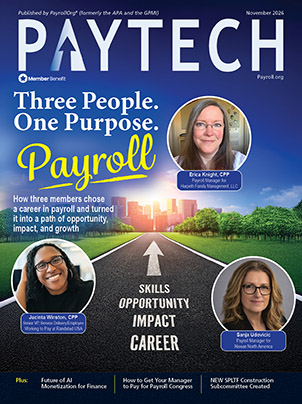 For more articles like this, read PAYTECH magazine (available in both printed and digital formats), free for PayrollOrg members!
PayrollOrg (PAYO), is the leader in payroll education, publications, and training. This nonprofit association conducts more than 300 payroll training conferences and seminars across the country each year and publishes a complete library of resource texts and newsletters. Representing more than 20,000 members, PAYO is the industry’s highly respected and collective voice in Washington, D.C. Get more information at www.payroll.org.
Not a member of PAYO? Check out the many benefits you get when you join!
