
AI, Talent, Trust Take Center Stage at Payroll's Executive Summit
The third annual Executive Summit, held during the 2026 Payroll Congress in May, featured a select group of payroll executives convened to build insights and engage in focused networking. Hosted by PayrollOrg and sponsored by Strada, the program combined peer-led panels and interactive discussions on such topics as artificial intelligence (AI) governance, data quality, operating models, workforce trends, and the changing expectations placed on payroll leaders.
 From Processing to Strategy: How AI Is Reshaping Payroll Leadership
AI is pushing payroll from a processing function toward a strategic, data-governance, and workforce-advisory role. Executive Summit panel discussions pivoted around AI integration, such as AI-enabled decision-making functions, and the gaps in governance, data quality, and system strategy.
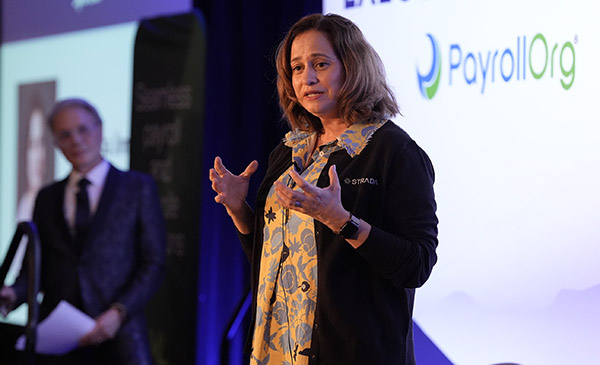
Melissa Jiminez, Senior Director, Product Strategy and AI at Strada, opened the Executive Summit by sharing how organizations can move beyond isolated AI tools to build enterprise-wide capabilities that deliver lasting business value. She cautioned there are expenses when building AI. Drawing on Strada's own transformation, she outlined the company's three-pronged approach as the following:
- Equipping every employee with practical AI skills.
- Establishing a secure and federated development model that enables the business to safely develop its own AI solutions.
- Creating scalable AI capabilities for customers.
She emphasized that successful AI adoption is not simply about technology, but about combining governance, education, and innovation to empower employees while delivering measurable business outcomes. Her remarks set the stage for a broader discussion on how organizations can scale AI responsibly while creating long-term value for both their business and their people.
Samantha Williams, VP, Head of Global Payroll at NielsenIQ (NIQ), participated in an executive case study, “Global Payroll Strategy: How AI Is Shaping Future Operations” with Gregory Peck, SVP, North American Commercial at Strada. They explored NIQ’s global payroll transformation journey and the strategic partnership with Strada as their single global payroll provider. NIQ is undertaking a significant global payroll modernization program, transitioning 84 countries across 65 different payroll platforms into Strada's payroll ecosystem.
A central theme of the discussion was the variety of payroll operating models that exist across the organization. The conversation included how AI is beginning to reshape payroll implementation and migration activities. One of the most promising use cases is data migration, where AI can accelerate the cleansing, mapping, validation, and conversion of payroll data from legacy platforms to new systems.
By reducing manual effort and identifying anomalies earlier in the process, AI has the potential to improve both implementation speed and data quality. To motivate her team to embrace these changes, Williams reinforces new skills learned and new opportunities for the team.
The discussion concluded with a broader view of the future of payroll, where global standardization, intelligent automation, vendor consolidation, and AI-driven insights will continue to transform the payroll function from a transactional service into a strategic business capability.
 The Future of Work and Pay
Global workforce characteristics and management challenges were central to a Payroll Congress general session keynote address “Zconomy: Decoding What Drives the Gen Z Workforce,” sponsored by ADP, that Executive Summit attendees were invited to.
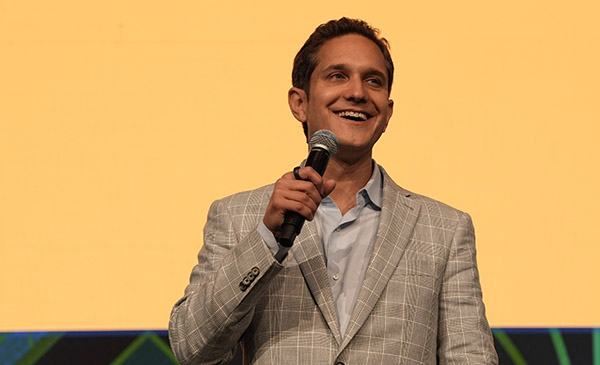
Jason Dorsey, President and Co-Founder of The Center for Generational Kinetics and a best-selling author, took a deep dive into understanding generational shifts as a precursor to corporate performance. Dorsey “translates” generational characteristics into managerial guidance, such as, “Make hiring and communication fast, mobile-friendly, and transparent,” and “Offer clear growth, stability, useful feedback, and a workplace culture that reflects stated values.” Read more about Dorsey’s research in the March 2026 PAYTECH cover story or in Congress Today Online. Also, listen to Dorsey’s Fireside Chat, hosted by Tonya James, ADP’s Vice President of Product Management for Global Payroll.
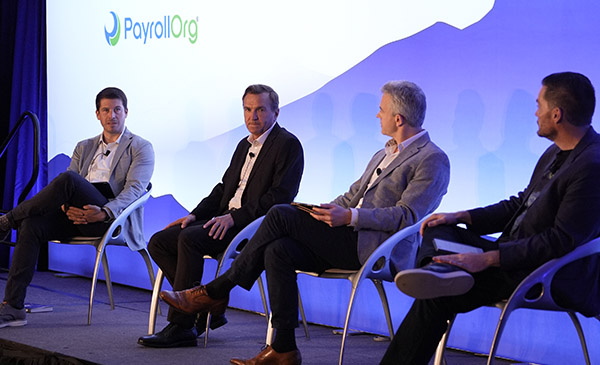 The Power of the Panels: Discussion About The $50 Billion Question
Nick Day, CEO of JGA Recruitment Group, moderated a panel during the Executive Summit, titled “The $50 Billion Problem: Payroll, Power, and AI” with Greg Harmer, VP of HR Shared Services at CVS; Nathan Male, Partner at Deloitte; and Joe Ranzau, Partner at Grant Thornton.
“I built this panel around a contradiction,” said Day. “Over the last 12 months, capital markets have placed more than $46 billion of explicit valuation on payroll and workforce infrastructure through numerous high-profile deals. By any measure, the investment community has decided payroll is strategically valuable. And yet, when I speak to payroll leaders around the world, the majority still tell me they are treated as a back-office function.”
Day made that gap the starting point of the discussion and structured the session around three sections:
- The commercial reality behind private equity (PE) investment in payroll.
- The AI readiness and talent challenge.
- The vendor and system strategy decisions that global payroll leaders are dealing with right now.
“I deliberately put two advisers (Joe and Nathan) alongside one operator (Greg) to create tension between theory and reality,” he explained.
For example, Harmer answered the question of where AI had actually made a measurable difference inside payroll. Day said his answer was not what anyone expected.
“Greg made the case that the entire industry had just let a major practical AI opportunity go by,” said Day. “In the United States, the One Big Beautiful Bill Act (OBBBA) changed the tax treatment of overtime and tips in April 2025, retroactive to the start of the year. But the IRS did not update withholding tables. Employers were not told to treat income differently. So, tens of millions of hourly workers who qualified for the benefit would only get their money back by filing a tax return.
“The problem, as Greg pointed out, is that a huge proportion of American hourly workers who receive a W-2 never file. He estimated the average benefit left on the table at ‘roughly $500 per hourly worker.’ His challenge to the room was simple: who was going to help those employees take advantage of this, if not payroll?”
As the discussion shifted to business strategy, Male pointed out that, “What the CFO actually wants to talk about is talent strategy, workforce investment, and the commercial value of the data." Payroll as the owner of data can inform on these discussions. The CFO is likely not focusing on compliance.
 Managing the Machines
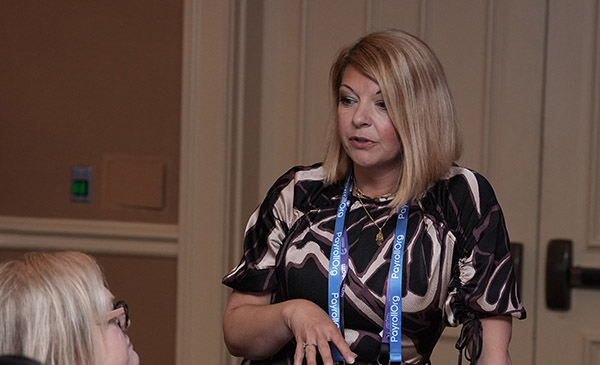
Wendy Muirhead, Founding Partner, WH People, led “Managing the Machines That Manage Us: Service, Pay, and Power in the Age of Automation,” focused on the intersection of human responsibility with the algorithm-driven AI decision-making and its implication across service models, governance structures, earned wage access (EWA), and the operating models required to deliver ethical, robust payroll at scale.
 Key Summit Takeaways
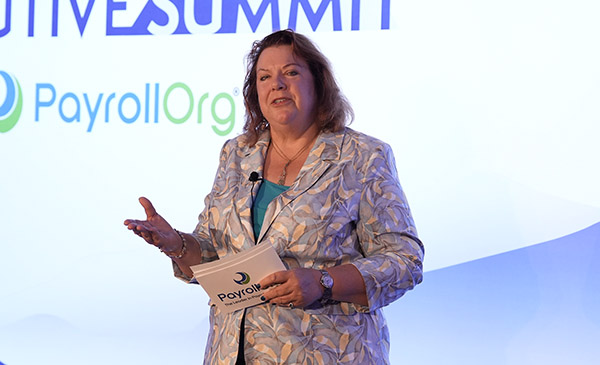
The Summit concluded with a post-lunch interactive discussion, moderated by Peck and Linda Obertin, CPP, Global Payroll Leader at Hilton Worldwide, fueled by conversations and takeaways. One such takeaway came from Brent Skinner, an Executive Community Lead at HR.com.
“As technology emancipates payroll professionals from the yeoman's work of conventional payroll processing, the only thing that can happen then is for payroll leaders to pivot and begin acting with intentionality from a higher plane, positioning themselves from an empowered vantage point vis-a-vis interactions with the CFO and others in the C-suite,” he said.
Obertin noted that new technologies, shifting workforce expectations, global complexities, and increasing business demands mean that leaders are constantly looking for ways to learn, adapt, and stay ahead. That is exactly why the third Executive Summit in Nashville, Tenn., was so valuable.
What makes an event like the Executive Summit different are the practical experiences and strategies of the participants. Leaders are not just looking for presentations; they want to hear real stories from peers who have faced similar challenges, made difficult decisions, learned from successes and setbacks, and found innovative, strategic ways to move their organizations forward.
This year's Summit went beyond theory into practical experience, which as Obertin said “often provide the most meaningful takeaways because they can be applied immediately in our own businesses … We heard about real world workforce transformation and building regional service delivery models as an organization evolved their global strategy.”
Frank J. Mendelson is the Acquisitions Editor for PayrollOrg.
